
Beginner's Mind
Erin Lingo | FEB 4, 2023
beginner
yoga
somatics
shoshin
Beginner's Mind
Erin Lingo | FEB 4, 2023
When was the last time you tried something new? If you can, take a moment now and visualize yourself back in that experience. How did you feel? What inspired you to walk through the door of that class, training, or place? You might clearly remember the feeling in your body, or your heightened senses: where you stood, what you were wearing, who else was there. Or maybe not, especially when time has passed - sometimes being out of our comfort zone sends us into a mildly activated state and our memory function isn't quite clear.
Two memories stand out to me, where I walked into something new, by myself: the first time I walked into a yoga class (omg, 20 years ago), and taking the huge plunge into coaching training a couple years ago. Maybe it’s my poor memory for details, or the time passing, but I remember almost nothing about what brought me to my first yoga class, or how I felt being there - only that it was a prenatal class, and a quiet sense of confidence that I was doing something good for myself during my pregnancy. But I remember with detail my excitement when I signed up for coaching training, the feeling of overwhelm when I got momentarily lost on the drive in the mountains outside Asheville, the nervousness I felt walking into the lodge and meeting cohort members, and the emotional release of sensing I was in a safe place.
Let’s acknowledge right off the bat that doing something new can be scary! It requires that we step out of our comfort zone, away from our assumptions and expert minds, and embrace the unknown, the unexpected, and worse yet, admit that we don’t know everything. It can be uncomfortable and awkward, and in some circumstances we might freeze up or clam up, put up emotional armor of self-protection, and even come across as stand-offish or distant.
Why?? Our brains love to shortcut us into comfortable and habitual behaviors and actions. Over time our thought patterns become well-traveled neural pathways - we tend to surround ourselves with affirming information, environments and experiences that are comfortable and where we feel like we are seen as experts, and respond in habitual ways. Close-mindedness is a technique of self-preservation and ego-defensiveness. Unfortunately, this means that if we don’t pay attention, we can close ourselves off to new experiences, the feedback and wisdom of others, and start feeling a little stuck.
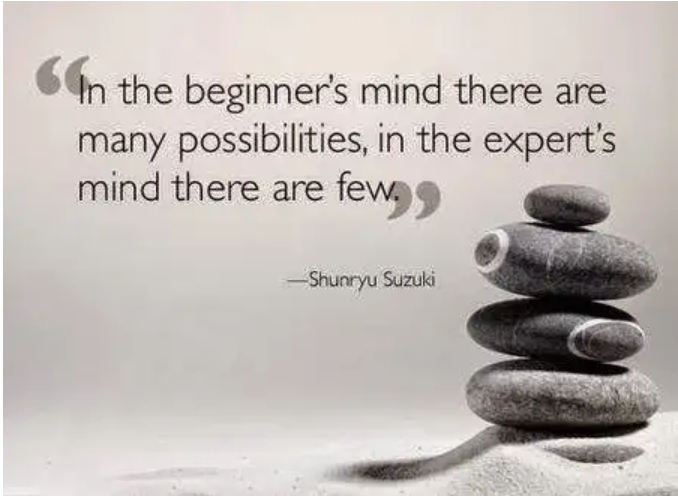
But the Zen Buddhist concept of Shoshi - “the beginner’s mind” - tells us there are benefits to embracing the unfamiliar, even when it’s difficult. We have to choose to cultivate that beginner's path with intention and attention, be willing to set aside our need for comfort, and choose to get curious, vulnerable, and seek connection.
Why is it important? Why would we choose to be a beginner? Developmental psychologists and spiritual traditions have long told us that we have a natural drive toward growth, a longing to help others, or to leave a lasting impact. It is a striving to understand ourselves as part of something bigger than ourselves, to find purpose in life. It may also be an internal drive toward wellness, to influence, to express and create, for self-generation. This state of openness, of curiosity, also helps us have more choice in our responses when an event triggers us. This might even sound like the antidote to the status quo, the staleness of experience that results from “just getting through it”, or feeling stuck. In fact, we have a bunch of reasons to want to intentionally cultivate a beginner’s mind.
A beginner, especially when feeling safe and connected, has limitless boundaries, possibilities, openness in expectations and to new ideas, an eagerness to learn and experience, a thrill at new experiences, curiosity, and wonder. Awe. You might imagine how this feels: a bubbling of creativity, sense of playfulness, or a quiet gratitude and connection.
So how do we cultivate it? In no particular order and in no way exhaustive, here are some practices that help me tap into my beginner’s mind:
Remember, this is a state, not a trait. The Beginner’s Mind is not something to achieve, rather to embrace, consistently and intentionally. I’d love to hear how you cultivate a sense of wonder, of newness, of beginnings.
Erin Lingo | FEB 4, 2023
Share this blog post
 OfferingTree